From 13 pilot gyms to full rollout in 10 months.
The problem
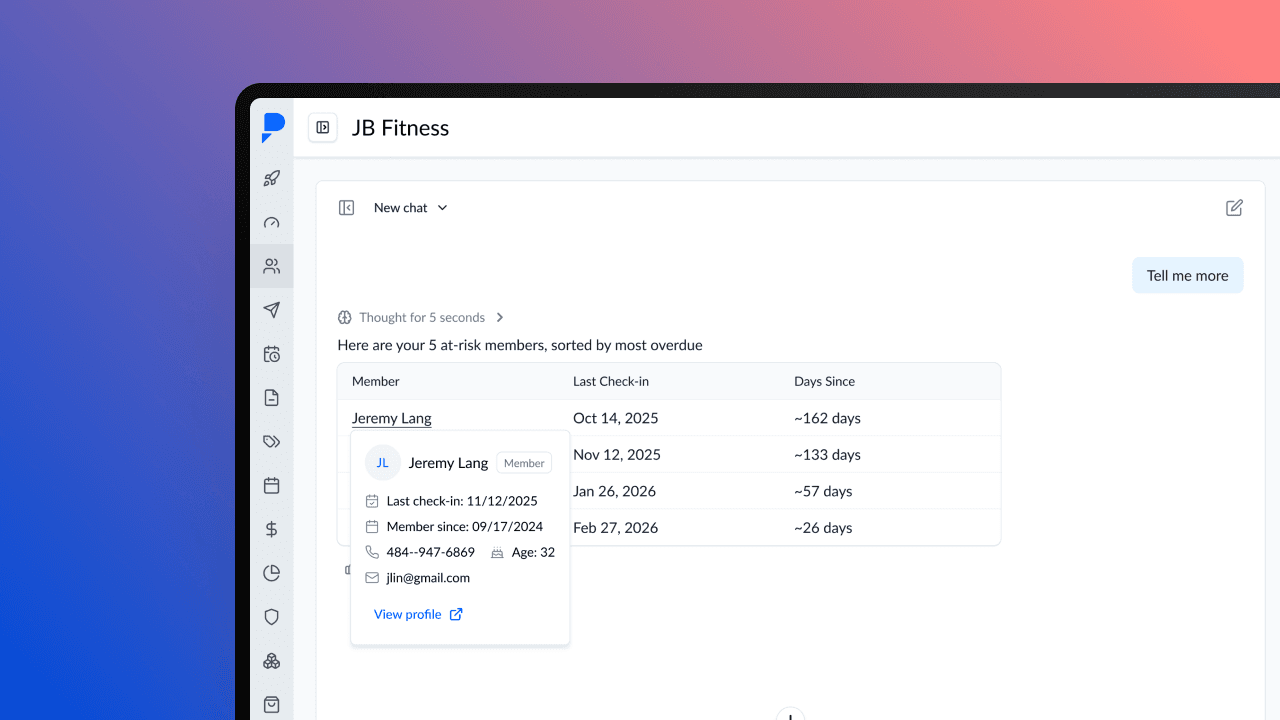
“Who's at risk right now?” That's how gym owners actually think, not in reports. The data existed in the product all along, it was just scattered behind screens and filters.
What I owned
- →Design lead for AI Assistant 1.0 and the full 2.0 rebuild.
- →Co-developed the Trigger → Inform → Action interaction framework that governs how the assistant confirms and executes state-changing work.
- →Built and shipped the AI component library into the PushPress Figma design system.
- →Ran the research. 103 beta conversations into 8 intent buckets; alpha analysis across 8 gyms and 86 messages.
- →Owned GTM and adoption strategy through alpha, Inner Circle, waitlist and GA.
- →Redefined how the company measures adoption for the assistant.
Key decisions
Answer and act, not answer and hand off
The assistant executes inside the conversation: charge the no-show fee, pause the membership, switch the plan, instead of explaining where to click. This was the bet the 103-conversation analysis pointed at, and it wasn't the cheap option. Every write action needed a confirmation model, a rollback story, and a permissions story.
ResultA 7.6× increase in gyms actively using the assistant after 1.0 launched. 13 to 112 across the Inner Circle cohort, Aug to Nov 2025, alongside 7× growth in monthly conversations.
Reframe 2.0 around insight, not just action
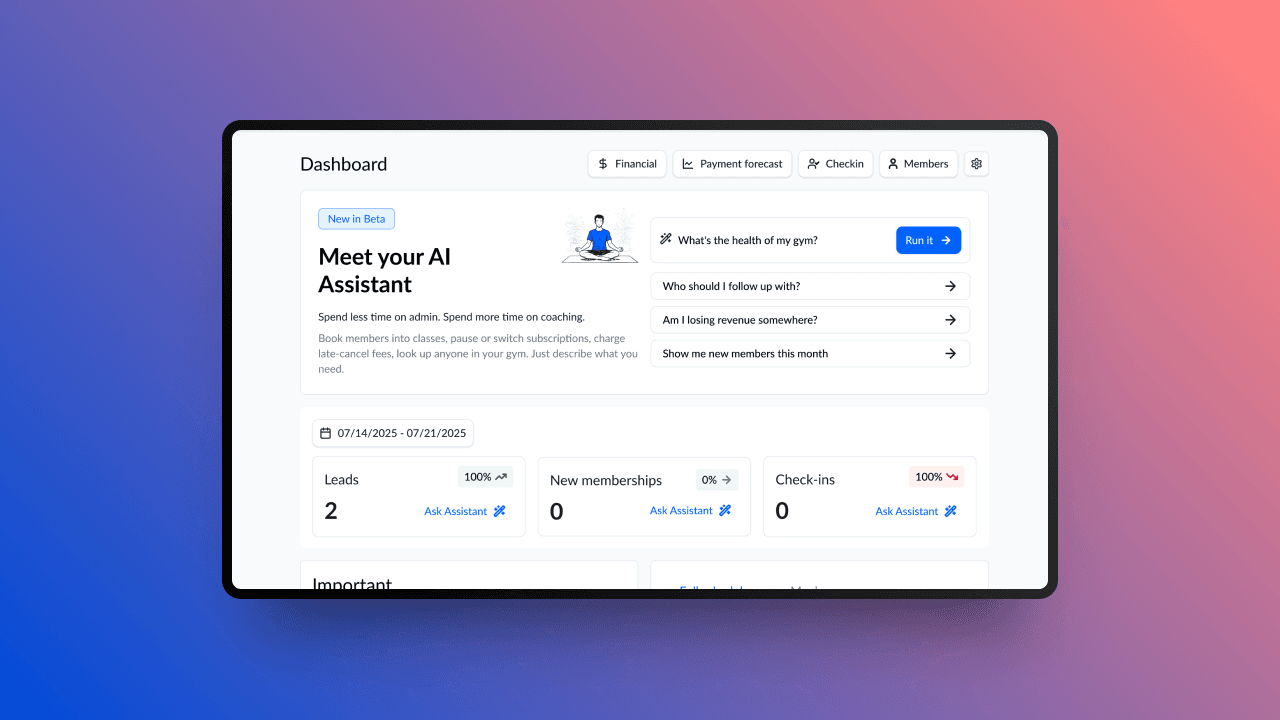
Usage data from 1.0 showed a gap I hadn't designed for. Owners were using the assistant to act, but the questions they abandoned were the ones about understanding: what's my churn, who's missing, how did attendance trend. The alpha analysis made it concrete. At-risk member queries came from 3 gyms and resolved zero times.
ResultCapabilities expanded from 9 to 48+ intents, a 433% expansion, and the usage mix rebalanced to roughly the split we designed for: 34% insight and data pulls, 37% commands and actions, 17% how-to.
Build the AI component system before the screens
Rather than designing one-off surfaces, I built the AI component library up front and shipped it into the PushPress design system. Every surface after that inherited the same confirmation patterns, streaming states, error handling, and empty states.
ResultThe assistant went from 8 alpha gyms to 100% of Pro and Max gyms in twelve weeks, with success rate climbing through the rollout instead of degrading under it — high-80s to a consistent 95%+.
Change the definition of adoption
We were reporting "one prompt and done" at 32% and calling it the drop-off number. It was flattering and wrong: it only counted users who sent a single message, so anyone who asked three follow-ups in one sitting and never returned was scored as engaged. I pushed the team to a session-based baseline — one session and done, 45% — and to define Adopted as active on 3 different days within the first 14. That threshold captures 31.5% of users, and 58% of them go on to become long-term users, which beat every prompt-volume threshold we tested.
ResultThe org stopped optimizing for prompt count and started optimizing for return behavior. It also meant reporting a worse number to leadership on purpose.
Capability wasn't the bottleneck for long. Failure rates fell across the board: marketing and messaging went from 15.3% to 1.5%, most topics under 1%, first sessions failing just 3% of the time.
The real leak: 45% of users had one conversation and stopped. 76% of gyms had one staff member try it and stopped. People liked what we built. They just didn't come back.
The part I got wrong
I built the dashboard tiles around the most impressive first answer, a full gym health audit, the kind that makes someone say “oh.” It worked as a demo, not an on-ramp. Users who started there were 55% one-session-and-done. Users who started with a narrow prompt, “who are my latest leads?”, were 19%. Nearly a 3x gap, opposite of what I expected.
Makes sense in hindsight. A strategic answer is complete: you get it, you leave. An operational answer hands you the next question, and a reason to come back tomorrow. Impressive and habit-forming are close to opposites.
And the second lever wasn't conversational at all
Gyms with two staff users generated 5x more prompts than gyms with one. Three or four staff, 14x. The biggest untapped growth lever wasn't a better answer, it was getting a second person at the gym to open it once.
Retention closed the quarter at 56%, against a 50% target, so this moved. But it was still open at handoff, and it's where I'd spend the next quarter.
“The hardest part of an AI product isn't the answer. It's the second session.”
Owning GTM alongside design is what made that visible. If I had only owned the screens, I would have shipped a more impressive first answer and called it a win.