Overview
Gym owners don't think in systems — they think in people and situations. "Who's at risk right now?" "What's going on with my gym this week?" "Do I need to follow up with anyone?" Those aren't report queries. They're real questions about the health of a business.
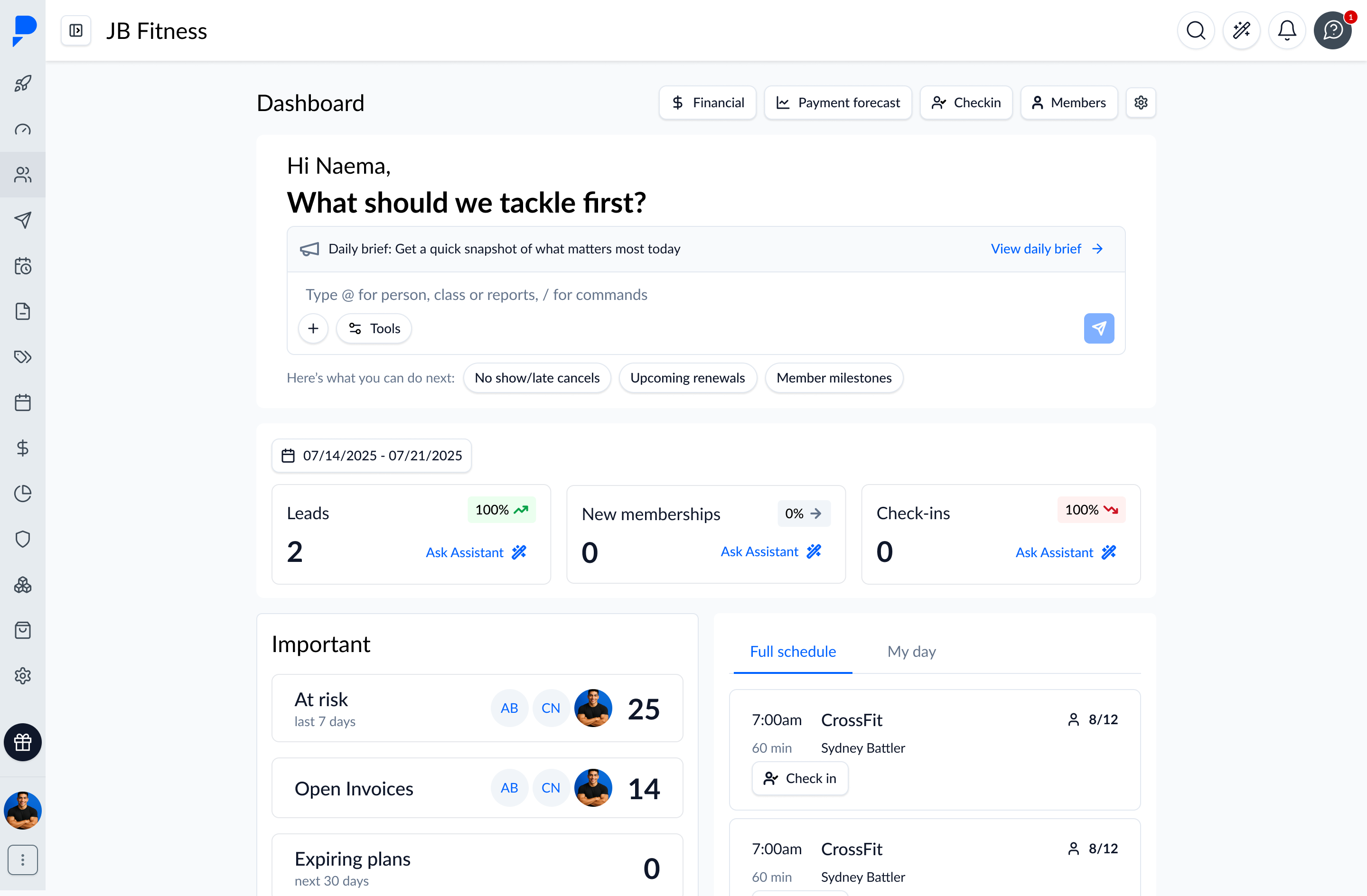
The AI Assistant lives inside PushPress Core and answers those questions in plain language — then lets the owner act in the same conversation: update a membership, charge a no-show, book a recurring class. No reports to run, no screens to hunt through.
I led design for the Assistant from the original prototype through the 2.0 rebuild, and as the product moved toward general access I also took ownership of the go-to-market and adoption strategy — defining rollout outcomes, building in-product education, and running experiments focused on the real challenge: not whether the Assistant can answer, but whether owners come back a second time.
Role
Design Lead + GTM owner
Timeline
Aug 2025 – present
Team
Product Manager, Product Designer, Engineering team
Surface
PushPress Core (web)
What I owned
Design lead, AI Assistant 1.0 & 2.0 — interaction model, conversation UI, embedded action components, and user-education flows.
Interaction framework — co-developed the Trigger → Inform → Action model that governs every proactive AI moment in the product.
AI design system — built and shipped a full suite of AI components to the PushPress Figma library: Message, Conversation, Task, Suggestions, Prompt Input, Reasoning, Sources, Chain-of-Thought.
Foundational research — analyzed 103 real beta conversations into 8 intent buckets that set the 1.0 priorities and seeded the 2.0 scope.
GTM & adoption — defined rollout outcomes with the PM, built the PLG dashboard and onboarding education, and ran the adoption experiments.
The problem
Everything an owner needs to run their gym exists in Core — but you have to know which report to run, which screen to click into, which filter to set. That's friction every single day. SMB operators rarely know what they should be asking a free-form chatbot, so a blank text box is intimidating, not empowering.
The design challenge
Translate how an owner thinks into something the product can act on. Demonstrate value fast enough that a skeptical operator tries it. Then give them a reason to make it part of their week.
The information wasn't missing — it was scattered. The design work was never just "build a chatbot." It was: surface the right thing at the right moment, make acting on it frictionless, and earn enough trust that it becomes a daily habit.
Research
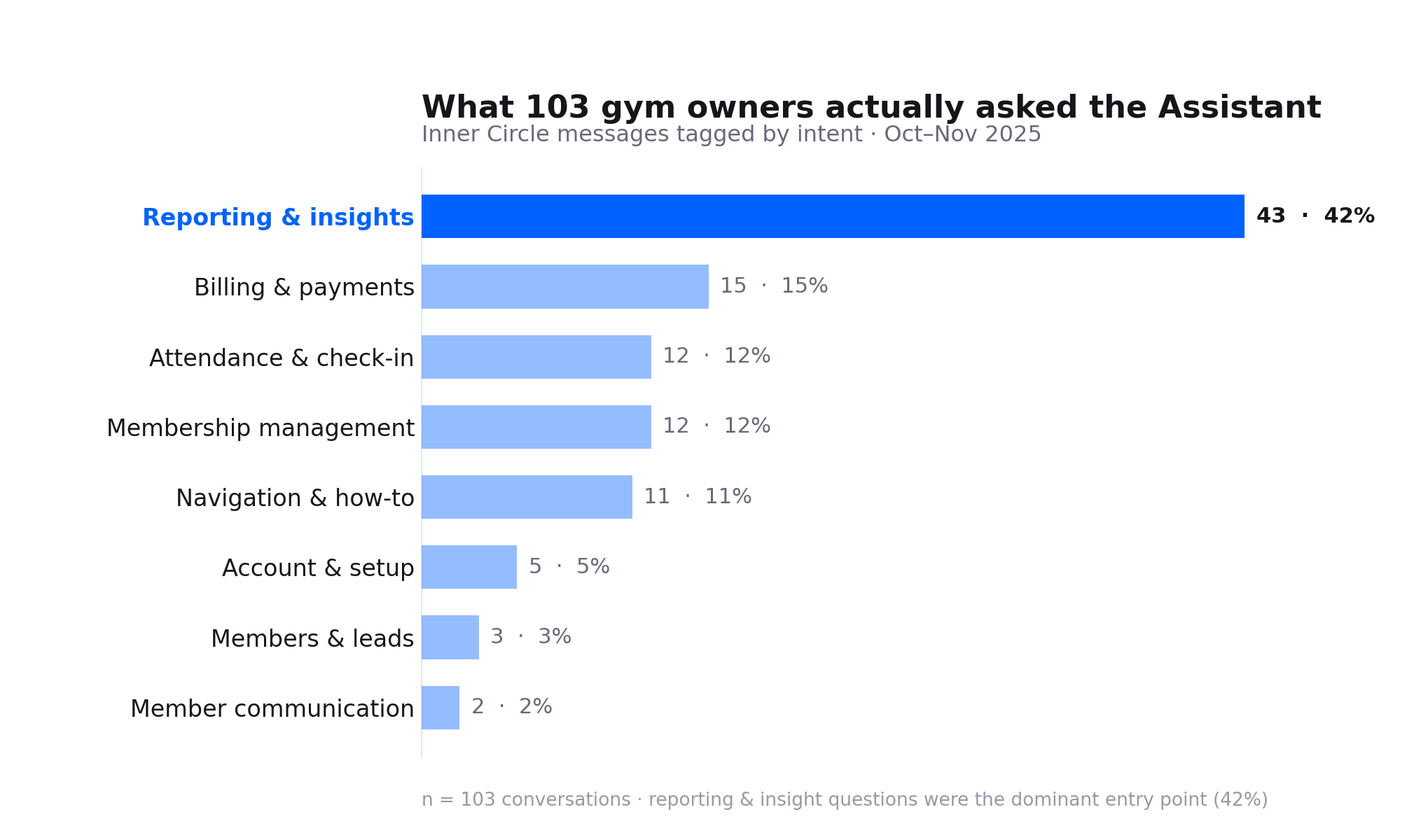
During the first beta I categorized 103 real Inner Circle conversations into 8 usage buckets. The finding that shaped everything: membership-lifecycle questions dominated, but class reservations and reporting were emerging and badly underserved. Those emerging categories became the centerpiece of 2.0.
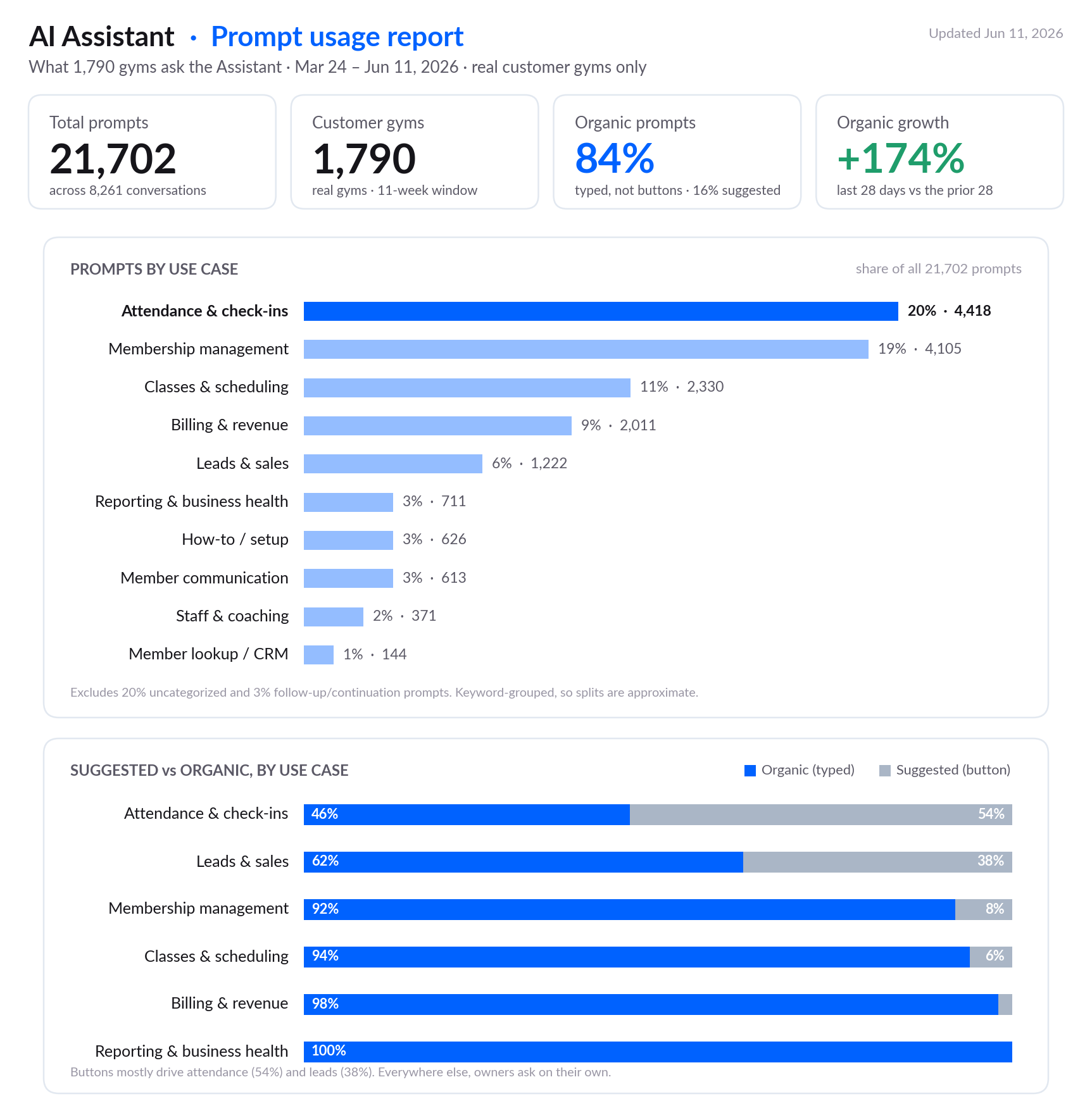
As rollout scaled, I led a usage analysis of 21,702 prompts from 1,790 gyms. It reframed the whole adoption conversation:
Capability is no longer the bottleneck. Failure rates collapsed below 1% on nearly every topic.
The leak is after the first session. 45% of users only ever had one conversation.
Adoption doesn't spread inside the gym. 76% of gyms only ever had one staff member try it.
Design decisions
1.0 — Prove the model
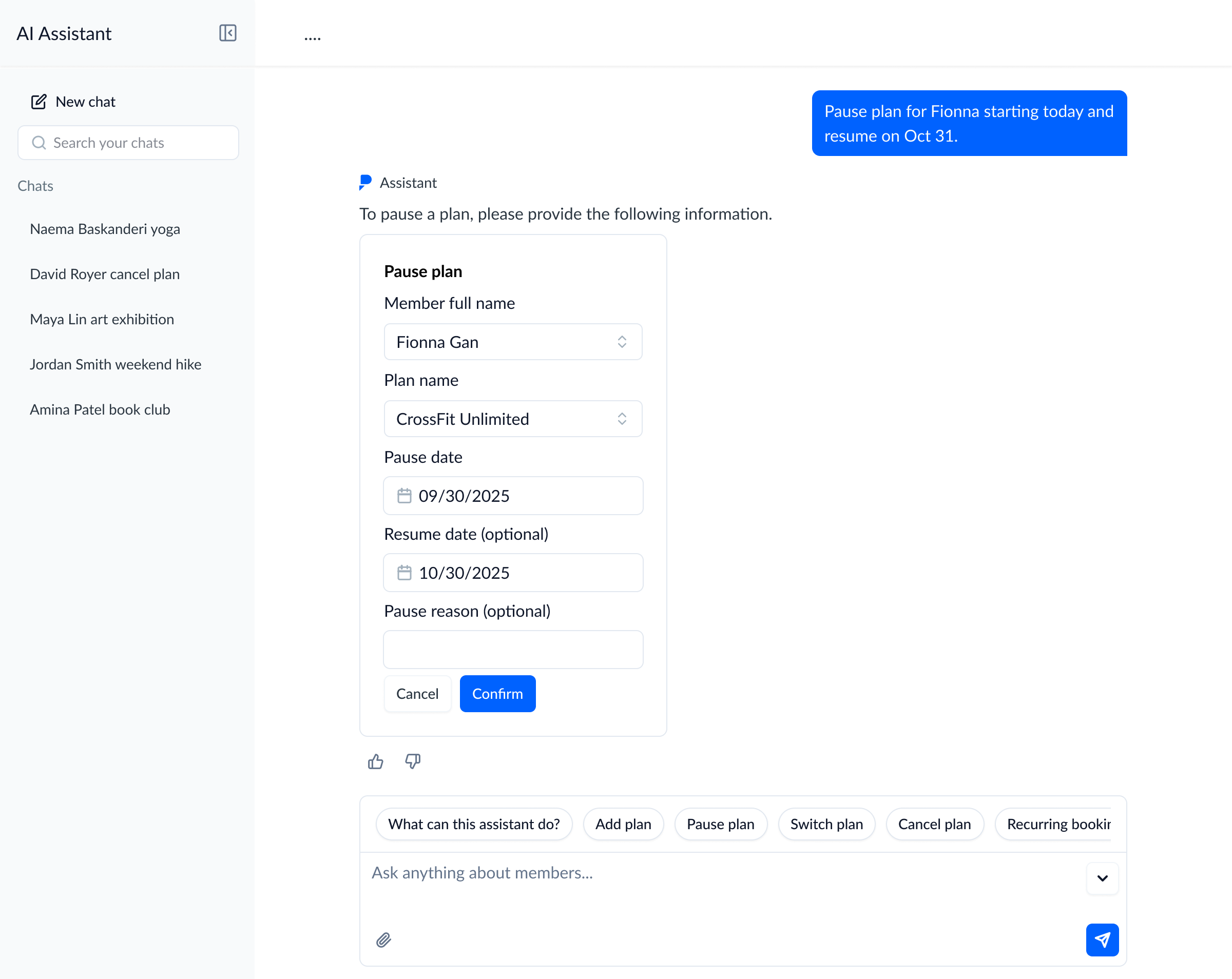
The original Assistant established the interaction model: conversation UI, quick actions, and embedded components that executed membership actions instead of just describing them. It shipped to all 106 Inner Circle gyms with 25 tool calls — and drove a 7.6× increase in gyms using it and a 7× increase in monthly conversations between August and November.
2.0 — Rebuild around insight + action
For 2.0 I led the design sprint and worked with the PM to reframe the product around insight and reporting, not just task execution. We introduced a new architecture, cleaner UX, user-education flows, and expanded intents including bulk-charging late-cancel and no-show fees. Capabilities grew from 9 to 48+ — a 433% expansion. Co-developing the Trigger → Inform → Action framework gave every proactive moment a consistent logic.
The AI component system
None of this scales without a system. I built and documented a full suite of AI-specific components in the PushPress Figma library — Message, Conversation, Task, Suggestions, Prompt Input, plus novel patterns like Reasoning, Inline Citation, Sources, and Chain-of-Thought — with usage rules so engineering and design stay aligned on when to use each. Every new surface shipped faster because of this foundation.
Go-to-market
Rather than a fixed launch date, we ramped access in cohorts and let usage and demand decide timing. I defined the rollout outcomes with the PM and built the in-product education and positioning that went out with each wave.
Inner Circle beta
First cohort of internal + IC gyms. 13 → 112 gyms using the Assistant by November.
2.0 soft launch
Released to the first 8 customers. 15 conversations in week one — a deliberate crawl to catch edge cases before scaling.
Early Access expands
Waitlist + targeted cohorts: unengaged, churn-risk, free-active. 390 conversations the week of Apr 27 — a 26× jump in six weeks.
Percentage rollout + PLG dashboard
From ~780 → ~3,200 gyms via staged rollout and an automated access form. The PLG dashboard ships mid-month — WAU grew 1.7× the week it launched.
General Access
Available to 100% of Pro and Max gyms. Request form retired. New customers get access by default.
The usage ladder
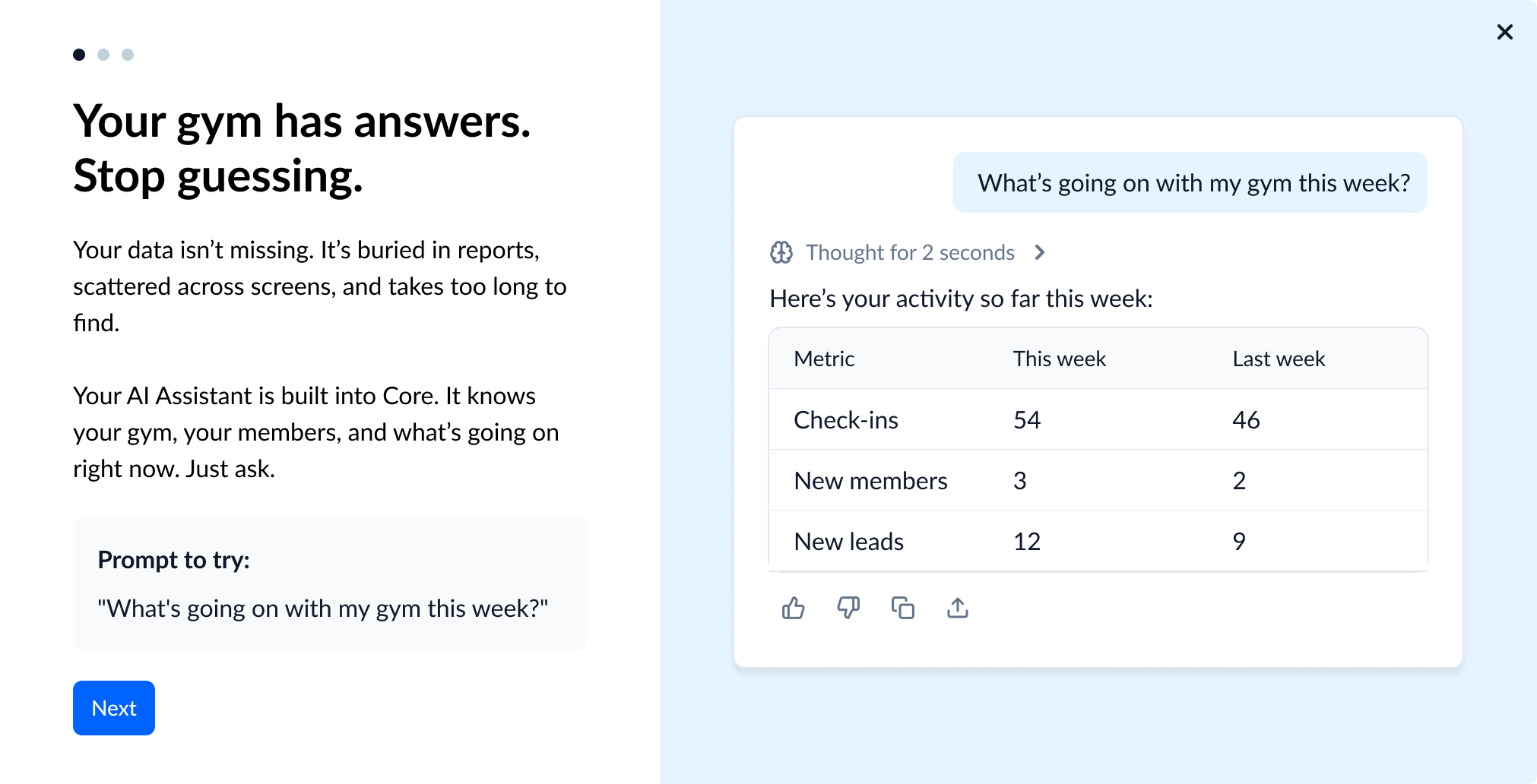
Counting prompts says nothing about whether the Assistant actually matters to a gym. So I helped define a shared four-level model the company now uses to talk about usage — in product copy, lifecycle emails, sales demos, and the prompt library. The jump from Insights to Decisions is where the value compounds.
Quick Actions
Get information or complete a task
The on-ramp most users start on. "Charge the late cancel fee for @member." "Who's checked in for the 5pm class?"
Insights
Understand what's happening
The Assistant connects the dots — trends, retention, attendance, revenue. "What's my churn rate over the last 3 months?"
Decisions
Figure out what to do next
It becomes a business partner, not a tool. "Who should I be paying attention to right now?" "Where am I losing members?"
Strategy
Plan the business
Part of how an owner thinks about growth and retention. "Build me a retention plan for next quarter." "Run a quarterly business review with me."
Each level is anchored to a real customer story — the framework gives every team one shared language for what "good usage" looks like, and a target to move users toward.
Access was solved. Habit wasn't.
By general access, capability and reach were healthy — but the usage analysis exposed the real problem. Growth was invite-driven, not adoption-driven, and the funnel leaked right at the top.
The encouraging signal: once owners are in, they engage on their own terms. 84% of all prompts are typed, not suggestion-button clicks, and organic prompt volume grew 174% in the four weeks around GA. Engagement isn't the question — return is.
Finding 1 — Operational prompts build habit. Strategic ones don't.
Users who started with strategic dashboard tiles were one-session-and-done 55% of the time. Users who started with narrow operational prompts: only 19%. A comprehensive answer gives someone what they came for and they leave. An operational task gives them a reason to come back tomorrow.
| Entry type | One-session-and-done | Avg prompts | Avg sessions |
|---|---|---|---|
| Strategic dashboard tiles | 55% | 4.3 | 2.1 |
| Free-form first prompt | 35% | 14.5 | 4.4 |
| Operational prompt | 19% | 15.9 | 6.1 |
Finding 2 — Adoption doesn't spread inside the gym.
76% of gyms only ever had one staff member try the Assistant. But gyms with two staff users generated 5× more prompts, and 3–4 users 14× more. Teammate adoption is the largest untapped lever — so experiments now target bringing a second person in, not squeezing one more prompt out of the first.
Finding 3 — Habit is measured in days, not prompts.
Active days predict long-term stickiness far better than prompt volume. I helped reframe the team's success metric from "one prompt and done" (32%) to the truer "one session and done" (45%), and proposed a new adoption definition: active on 3 different days within the first 14 — which predicts 58% of those users becoming long-term adopters.
Outcomes
13 → 1,790 customer gyms using the Assistant, from first beta cohort to general access
26× growth in weekly conversations across the 2.0 launch in six weeks
433% expansion in capabilities — from 9 intents to 48+
Below 1% failure rate on nearly every topic; marketing fell from 15.3% → 1.5%
95–99% task completion rate, held steady through every rollout wave
84% of prompts are organic — typed by users, not suggestion-button clicks, across 21,702 prompts through mid-June
Adoption metrics — WAU, retention, one-session-and-done rates — remain the active focus. The work in flight rather than a finished result.
What I'd carry into the next AI product
The hardest part of an AI product isn't the answer — it's the second session. We over-indexed early on impressive first responses and accuracy, both of which we won. The work that actually moves the business is making the product operational enough that it earns a place in someone's week. Reframing the team's success metric around return behavior was as impactful as any screen I designed.
Owning GTM made me a better product designer. Defining rollout cohorts, writing positioning, and watching where each wave leaked closed the loop between a design decision and a business outcome in a way that no spec ever could. Designing the PLG dashboard and being accountable for the adoption number it was meant to move kept the work honest.
A system pays for itself. Building the AI component suite up front meant every new surface — side panel, dashboard tiles, onboarding modal — shipped faster and more consistently than it would have one-off.